
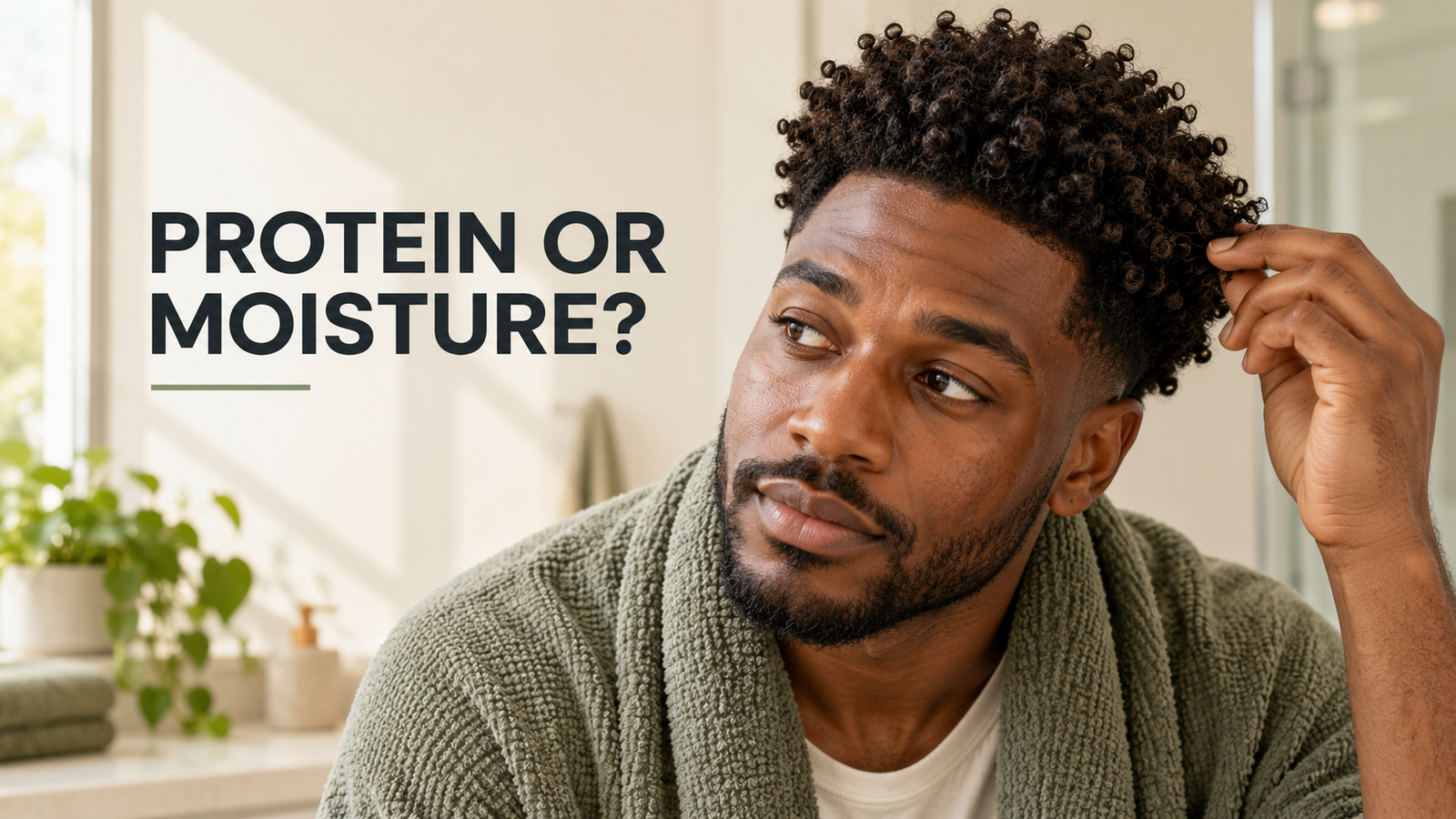
Your texturized hair doesn’t feel right.
Maybe it’s dry and rough. Maybe it’s too soft, stretches when wet or won’t hold the curl pattern the way it used to. You start searching for an answer and keep seeing the same advice: use protein if the hair is weak and moisture if it’s dry.
That sounds simple. Hair usually isn’t.
Dryness, chemical damage, product buildup, heat and rough handling can produce some of the same signs. A strand that snaps doesn’t automatically prove you need protein. Hair that feels soft doesn’t automatically have “moisture overload.”
One thing I want to make clear is that you don’t need to diagnose your hair from a single strand. You need to check for buildup, look at the whole pattern and test one change at a time.
Here’s a practical way to do that.
What Protein and Moisture Products Actually Do
Hair is made mostly from keratin, which is a protein. That doesn’t mean applying protein to the surface permanently rebuilds a damaged strand.
Protein-containing hair products commonly use ingredients such as hydrolyzed keratin, wheat protein, rice protein, silk protein, collagen, amino acids or peptides. Depending on their size and formulation, some may coat the surface while others can enter parts of the hair fiber.
One laboratory study on chemically relaxed, Afro-textured hair found that hydrolyzed keratin peptides behaved differently depending on their molecular weight. Some penetrated the cortex, while larger peptides mainly deposited on the surface. Certain treatments also reduced breakage during laboratory testing. That’s promising, but it doesn’t prove that every protein mask repairs every type of chemical damage.
The effect is cosmetic. Once hair grows out of the scalp, it cannot heal itself like skin. A treatment may improve strength, feel, smoothness or manageability. It cannot return texturized hair to its original structure.
Moisturizing and conditioning products help the hair feel smoother and more flexible, reduce friction and make detangling easier. Leave-in conditioner can be especially helpful for curly, dry, brittle or chemically treated hair.
Your hair may benefit from both types of products. The question is which one to try next—and how much.
Why the Stretch Test Doesn’t Give You the Whole Answer
You’ve probably seen this test:
- Take a wet strand.
- Pull it.
- If it stretches, use protein.
- If it snaps immediately, use moisture.
Treat that as an observation, not a diagnosis.
Hair behaves differently depending on whether it is wet, coated with conditioner, covered in buildup, recently processed, exposed to heat or already damaged. One strand may also come from a weaker part of your head.
Repeatedly pulling on questionable hair can create the breakage you’re trying to investigate.
A better assessment looks at several signs:
- How the hair feels after a proper wash
- Whether the ends and roots behave differently
- What products have been applied recently
- Whether the hair breaks during normal, gentle handling
- How it responds after one controlled product change
- Whether the result improves or worsens once fully dry
Don’t let one stretched strand talk you into applying a strong treatment to your entire head.
Signs Your Hair May Need More Conditioning
Start by reviewing moisture and conditioning when the hair feels:
- Dry or rough after cleansing
- Difficult to detangle
- Frizzy and inflexible
- Brittle mainly through the older ends
- Soft after conditioning but dry again once it finishes drying
- Hard to shape because the strands lack slip
- Worse after clarifying or frequent shampooing
Short texturized hair may simply feel rougher and lose its visible curl definition. Longer hair may tangle, catch during combing or feel dry through the ends while the roots remain fine.
In my older S-Curl maintenance routines, I talked a lot about deep conditioning because dryness was one of the biggest problems I noticed. That is still a sensible starting point when the hair feels rough and difficult to manage.
What I wouldn’t tell you now is that a mask permanently rebuilds chemically altered hair. It may improve the way the hair feels and behaves. That’s useful, but it’s not the same as reversing the texturizer.
A simple moisture-first test
Wash the hair and use your regular rinse-out conditioner. On damp hair, apply a small amount of true leave-in conditioner to one section.
Don’t add protein, oil, gel and curl cream at the same time.
Let the section dry completely. Compare it with the rest of your hair:
- Does it feel softer without feeling coated?
- Is it easier to shape?
- Does it tangle less?
- Does it remain flexible?
- Does the curl pattern look better when dry?
If it improves, keep the routine simple and observe it through the next wash.
The American Academy of Dermatology recommends applying leave-in conditioner to damp strands and using the smallest amount that gets the job done. Its guidance also advises applying leave-in to the hair rather than the scalp, where buildup may cause irritation.
When a Protein-Containing Product May Be Worth Discussing
Take extra care when clean hair feels unusually weak or limp, stretches much farther than it normally does, feels gummy while wet, or has processed sections that feel weaker than the natural roots.
These signs don’t prove that protein is the answer. They can also point to significant chemical damage. If the hair is actively snapping, pause chemical services and get a professional assessment rather than relying on another mask.
For hair that is stable enough to handle normally, a protein-containing conditioner may be worth testing—especially if a similar product previously improved manageability. Use a product formulated for hair, follow its directions and test a small section before treating the whole head. Avoid jumping immediately to a strong treatment that hardens during use.
Judge the hair after the full product process is finished and the hair is completely dry.
If the section feels stronger and more manageable without becoming stiff, the product may have a place in your routine. If it feels harder, rougher or begins snapping more easily, stop using it.
What “Too Much Protein” Can Look Like
People often call stiff, rough hair “protein overload.” That description isn’t a medical diagnosis, and stiffness alone can’t confirm the cause.
The same feeling can follow a strong treatment, several products layered together, hard-hold gel, heavy residue, frequent clarifying, chemical damage or inadequate conditioning.
Before blaming protein, read the labels on your shampoo, conditioner, leave-in, mask and styler.
Protein-related ingredients may appear under names such as hydrolyzed keratin, hydrolyzed wheat protein, hydrolyzed rice protein, hydrolyzed silk, collagen, amino acids or peptides.
An ingredient appearing on the label doesn’t tell you exactly how strong the finished product is. Formula, concentration and the rest of the ingredients matter.
If multiple products contain protein and your hair keeps getting stiffer, pause the extras. Return to a basic shampoo, rinse-out conditioner and one leave-in. Give yourself a clean baseline before adding anything back.
The One-Change Hair Check
Instead of trying to solve the problem in one night, use this controlled check.
1. Reset the hair
Wash away the products already on your hair. If it feels greasy, waxy or coated after a normal shampoo, an occasional clarifying wash may help. Don’t turn clarifying into an every-wash habit.
Condition afterward. The AAD recommends conditioner after every shampoo as part of reducing avoidable hair damage.
2. Establish your baseline
Notice how the hair feels wet, whether it detangles normally, where breakage occurs, whether roots and ends feel different, and how it looks completely dry.
Take a few photographs in consistent lighting. Memory is unreliable when you’re switching products every few days.
3. Pick one change
If the hair is mainly rough, dry and difficult to detangle, test a moisturizing conditioner or leave-in. If you’re considering protein, choose one suitable product and follow its instructions. Get professional advice first if the hair is gummy, severely weakened or actively breaking after processing.
Keep the rest of your routine consistent. Many protein products also contain conditioning ingredients, so the goal is to test one product change—not to create perfectly separate “protein” and “moisture” categories.
4. Watch the next wash cycle
A good result shouldn’t only look impressive while the product is sitting on wet hair. Pay attention to softness after drying, definition, detangling, snapping, stiffness, residue and how long the improvement lasts.
If the hair becomes worse, stop. You don’t have to finish a month-long routine because someone online called it a “protein schedule.”
5. Keep what works and remove what doesn’t
Once you identify a useful product, don’t automatically add three more.
Your routine may only need shampoo, rinse-out conditioner, leave-in conditioner, one styler and an occasional targeted treatment.
The treatment should solve a problem. It shouldn’t become another mandatory step that leaves your hair harder to understand. If product choice is confusing, start with products that have a clear job in your routine.
What Protein Cannot Fix
Protein cannot make an overprocessed strand natural again. It also cannot fix ongoing chemical overlap, a burned scalp, tight styles pulling at the roots, daily high heat, severe split ends, an underlying cause of hair loss or continuous rough handling.
If your hair is actively breaking, postpone another texturizer application. Reduce heat and tension, detangle gently and condition after washing.
The AAD recommends handling textured hair with a wide-tooth comb while damp, using lower heat and avoiding repeated pulling. You can also review my tips for reducing everyday hair breakage.
Persistent scalp pain, sores, bald patches or thinning that continues after you simplify the routine should be evaluated by a board-certified dermatologist.
Frequently Asked Questions
Does every person with an S-Curl need protein treatments?
No. Chemical processing may make protein-containing products worth considering, but that doesn’t create a universal schedule. Start with the condition of your hair and the product directions.
How often should I use protein on texturized hair?
There is no standard frequency that fits everyone. A mild protein-containing conditioner and a strong treatment aren’t interchangeable. Follow the label, test the result and avoid stacking several protein products.
Can I use protein and moisture on the same wash day?
Yes. Some formulas already combine conditioning ingredients with hydrolyzed protein. If you’re troubleshooting, changing one product at a time makes the result easier to understand.
Does stiff hair always mean too much protein?
No. Stiffness can also come from gel, buildup, chemical damage or inadequate conditioning. Clean the hair and simplify the routine before deciding.
Does gummy hair always need protein?
No. Gummy or unusually stretchy hair can signal serious damage, especially after a chemical service, but a home test can’t measure the exact cause. Avoid another chemical treatment and seek professional help if the hair keeps snapping.
Can a protein mask stop texturizer breakage?
It may improve the physical properties of some damaged hair, but it cannot guarantee that breakage will stop. You also need to address overlap, heat, friction, tension and the condition of the ends.
Is dietary protein the same as a protein hair treatment?
No. Dietary protein supports the body and new hair growing from the follicle. A topical product acts on the existing hair fiber. Applying protein to the hair does not treat a nutritional deficiency.
Final Thoughts
If your texturized hair feels wrong, don’t rush to label it.
Check for buildup. Look at the roots and ends separately. Think about the products you’ve already used, then test one change on a small section.
Dry, rough hair may respond well to better conditioning. A protein-containing product may help some processed hair, but neither option can reverse chemical damage, and neither should be applied on autopilot.
Your hair doesn’t need a perfect “balance” calculated from one strand. It needs a routine simple enough for you to see what is actually helping.
Use the one-change check above during your next wash, and keep a quick note of what you used and how your hair felt once dry. For the broader routine, read my S-Curl maintenance guide.
0 Comments