
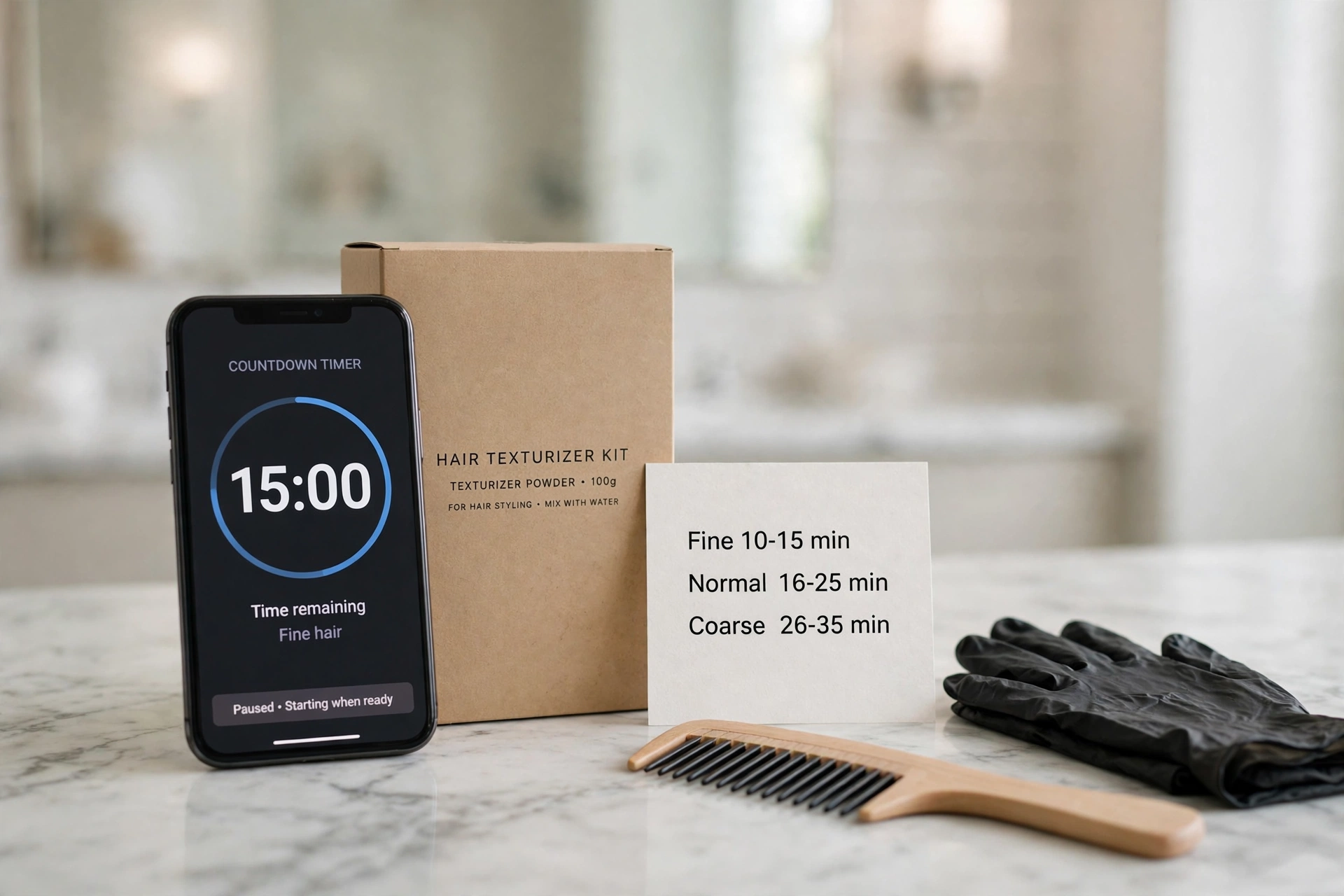
The quick answer — read this before the cream goes on
There is no single minute count that is right for everybody, and any page that gives you one number without asking about your hair is guessing with your head.
Here is the only chart that actually has authority here — Luster’s own, from the manufacturer of S-Curl. Use the time chart that comes with your kit to pick your range based on your hair texture:
- Fine: 10–15 minutes
- Normal: 16–25 minutes
- Coarse: 26–35 minutes
That is the answer. Everything below is how to use that chart correctly — because most timing mistakes are not really about the number. They are about when the timer starts, which strength you bought, and waiting for the wrong sign before you rinse. And one rule sits above the chart: the instruction sheet inside your exact kit outranks this article, every video, and every comment. If your kit’s chart and anything here ever disagree, your kit wins.
Why the internet tells you 5–10 minutes
Search this question and you will find blogs telling you a texturizer should only stay on for 5 to 10 minutes. Search a little more and you will find older how-tos telling you a flat 10 to 15 minutes for everybody, like hair texture is not a factor.
Those numbers are not all lying to you on purpose. Most of them are writing about texturizers in general — different products, different strengths, different hair — and then the next blog copies the range because it sounds safe and short. None of that is your kit. Luster makes a specific product with a specific chart, and that chart runs longer and wider than the generic blogs suggest, because coarse, resistant hair genuinely takes longer to loosen than fine hair does.
So you have two bad options if you follow the internet instead of the box. Follow the 5–10 minute blogs with coarse hair and you may rinse before anything has really happened, then blame the product. Follow a flat number with fine hair and you may sit there processing long past your range because a stranger’s routine said so. The chart exists specifically so you do not have to borrow somebody else’s head.
Your timer starts earlier than you think
This is the part almost nobody counts, and it quietly ruins more applications than the chart does.
Texturizer starts working on a section of hair the moment the cream touches it. It does not wait until your whole head is covered and you finally press start on your phone. If it takes you six minutes to apply, the first section you did has already been processing for six minutes while you were still working on the last section. Your head is not on one timer — it is on several, staggered by however long application took you.
That is exactly why Luster’s directions tell you to apply to the most resistant areas first — the spots that are curliest and slowest to loosen get the head start they need, instead of getting rushed at the end. Work in sections, work steadily, and know your range before the first scoop of cream comes out. The worst setup in the world is reading the chart for the first time with product already on your hair and the clock already running.
Practical version: set everything out first. Gloves on, timer where you can see it, neutralizing shampoo open and within reach. Decide your texture category and your maximum minute before you start, not during.
The strand test is how you find your number
The chart gives you a range. It does not give you your exact minute, because your hair has its own history — how coarse it really is, whether it has been processed before, how it responded last time. The strand test your kit describes is how you close that gap: test one small section, watch how it responds inside your range, and let that result set your plan for the full application.
Skipping it feels like saving ten minutes. What it actually does is turn your whole head into the experiment. A test section that comes out too straight costs you one hidden patch. A full head that comes out too straight costs you months of growing it out or cutting it off. Do the test.
What to watch while it processes
Guys tend to watch the clock and nothing else, or watch their hair and ignore the clock completely. You need both.
Watch the pattern, not the straightness. What you are looking for is the curl loosening into a softer S-pattern — the coil relaxing and elongating, not disappearing. If you are waiting until the hair looks straight before you rinse, you have waited too long. Straight is not the finish line of a texturizer. Straight is what over-processing looks like.
Check a strand instead of guessing from across the room. Smooth a small section between your fingers the way your kit directs and look at the pattern up close. And keep the end of your range as a hard wall, not a suggestion. “It doesn’t look done yet” at your maximum minute means rinse anyway and learn from the result — an under-processed application can be assessed and corrected next time. An over-processed one cannot be un-processed. There is no reverse gear on this.
Regular or Extra Strength changes the clock
Strength is the other half of timing that the comment sections always leave out. Extra Strength does not just work “better” — it works on your hair with more force, which means the same minutes do more. Two guys can both say “I left it in for 15 minutes” and get completely different results because one used Regular, one used Extra Strength, and their textures were different to begin with.
That is why copying a creator’s minutes — anyone’s — is a broken strategy, even when the creator’s hair looks like yours in a video. You do not know his exact texture, his strength, his application time, or how much of his result is the hair he started with. Use the chart for your texture, with your strength, on your head. Buy the strength that fits your hair instead of defaulting to the strongest box on the shelf, and if you change strength, treat your old timing like it expired — because it did.
Touch-up timing is a different problem
If this is a touch-up and not a first application, the timing rule changes in one important way: the product only goes on the new growth. The hair you already processed has had its chemical service. It does not get a second round of minutes just because it is sitting next to the new growth.
Overlap plus time is the exact combination that makes a touch-up come out straight and weak at the line where old hair meets new. So on a touch-up, your real skill is not the number — it is the stop line. Find where your tighter new growth ends and your looser processed hair begins, apply to the new growth only, and let the previously processed lengths sit this one out completely. Zero minutes is the correct processing time for hair that has already been processed.
That is the whole subject of this week’s video, “S-Curl Touch-Up: How to Reapply It Without Overprocessing” — watch it before a touch-up, because the line matters more than the clock on retouch day.
If it burns, the timer is cancelled
One thing outranks your range, your strand test, and your plan: your scalp.
If you feel strong burning, or stinging that keeps building instead of staying level, rinse it out. Do not finish your minutes. A burn is not the product “working,” and the time you save by pushing through is not worth a sore scalp and breakage at the root. Rinse thoroughly and neutralize with the shampoo from your kit exactly the way the instruction sheet directs.
There is a full breakdown of this in the companion article, “Why Does S-Curl Burn? Tingle vs. Burn and When to Rinse It Out” — a mild, steady tingle is one thing, pain that climbs is another, and that article gives you the level-by-level scale to tell them apart while the product is on.
Too long, too short: reading your result
Whatever happens, your result is information — if you write it down.
It came out straighter than you wanted. The usual suspects, in order: it stayed on too long for your texture, the strength was more than your hair needed, application time pushed your first sections past your range, or — on a touch-up — it overlapped onto processed hair. Straightened hair does not curl back up with product or patience; that result grows out or gets cut. What you control is the next application.
It barely changed. Also useful. Possibilities: you rinsed well under your range because a blog scared you, your hair is more resistant than the category you picked, or the product never really covered the sections evenly. Before you conclude the kit “doesn’t work on your hair,” check the boring explanations first.
It came out uneven — loose in front, tight in back. That is usually staggered timing showing itself: the sections applied first processed longest. It points back to application order and speed, not to the chart.
Write down four things after every application: the strength, the texture category you used, when you started, and when you rinsed — plus a photo in the same light. Next time, change one thing. That note is the difference between a guy who is guessing every box and a guy who actually knows his number inside the range.
FAQ
How long do you leave S-Curl in for 4C hair?
There is no separate chart by curl-pattern number. Luster’s chart goes by texture — fine, normal, coarse — and tight, coily hair that is coarse and resistant generally falls toward the coarse end of that system. But your kit’s chart and your strand test decide, not the number-and-letter label. Do not borrow a minute count just because someone shares your hair type on paper.
Can I just leave it in 5 extra minutes if it doesn’t look done?
No. Your range’s top end is the wall. If you reach it and the pattern has not loosened the way you expected, rinse, neutralize, and treat the result as data for next time — a longer sit is how “a little looser” becomes straight and weak.
Does the timer include application time?
The hair counts it even if you don’t. Cream starts processing each section on contact, which is why resistant areas go first and why a slow, unprepared application quietly over-processes the front while the back is still being coated.
Is the activator the same timing?
No. This article is about the texturizer cream in the kit — that is what the processing chart is for. The activator and moisturizer products used for daily maintenance are a different step in the routine and are not processed and rinsed on a timer like the cream.
What do I do right after I rinse?
Rinse thoroughly, then wash with the kit’s Color Alarm Neutralizing Shampoo the way the directions describe — Luster’s process is to keep washing until the suds rinse white, which signals the cream is out. Then keep your hands and your routine simple while you assess the result honestly before you judge it wet, styled, or under different light.
The bottom line
“How long did you leave it in?” is the first question asked every time an application goes wrong — in this channel’s comments, it comes up more than any other technical question. Now you know why the honest answer is a chart, not a number.
Find your texture category. Respect the top of your range. Count application time. Apply to the resistant areas first. Rinse when it burns, full stop. Write your timing down so the next box is a decision instead of a gamble.
And if your last application already went sideways — too straight, uneven, or barely changed — and you cannot tell whether it was timing, strength, or overlap, that is exactly what The Curl Audit is built to sort out. You send your hair history, your routine, and photos; I review them and send back a written plan in plain language. It’s $29 at the founding rate while the first 20 spots last. Get The Curl Audit → Then watch the Touch-Up video before your next application — the line and the clock together are the whole game.
This article is general hair-care education based on the manufacturer’s published directions — it is not a substitute for the instruction sheet in your kit. For scalp pain, sores, blistering, swelling, or hair loss, see a dermatologist.
0 Comments